
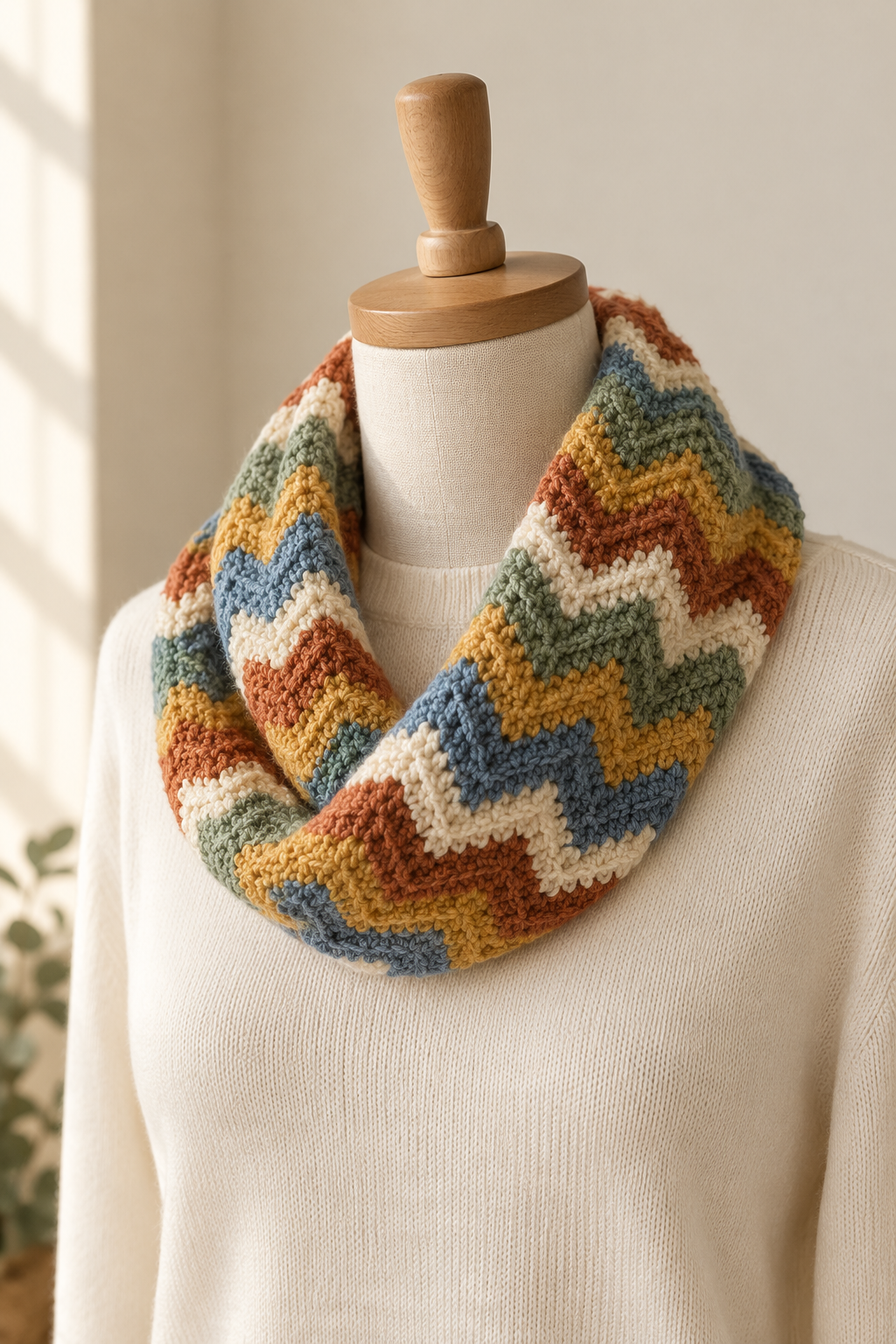
Chevron crochet looks like it should be difficult. All those peaks and valleys marching in formation, five colours stacked up, stripes that seem to travel.
But the whole thing rests on one trade you make once per repeat.
You take three stitches away at the bottom of each valley. Then you add three back at the top of each peak. Your stitch count never moves, yet the fabric rises and falls. Do that in five colours and the waves stack into stripes that chase each other around your neck.
So there is one repeat in this pattern. You work it over and over until the cowl is tall enough. No seam, no turning, no shaping to track.
Get Chevron Crochet Cowl Pattern on our Etsy Shop (Ad free and Image guide step by step)
What You’ll Make
| Size | Circumference | Height | Stitches | Repeats |
|---|---|---|---|---|
| Cowl | 28 in / 71 cm | 10.5 in | 90 | 6 |
| Infinity | 46 in / 117 cm | 10.5 in | 150 | 10 |
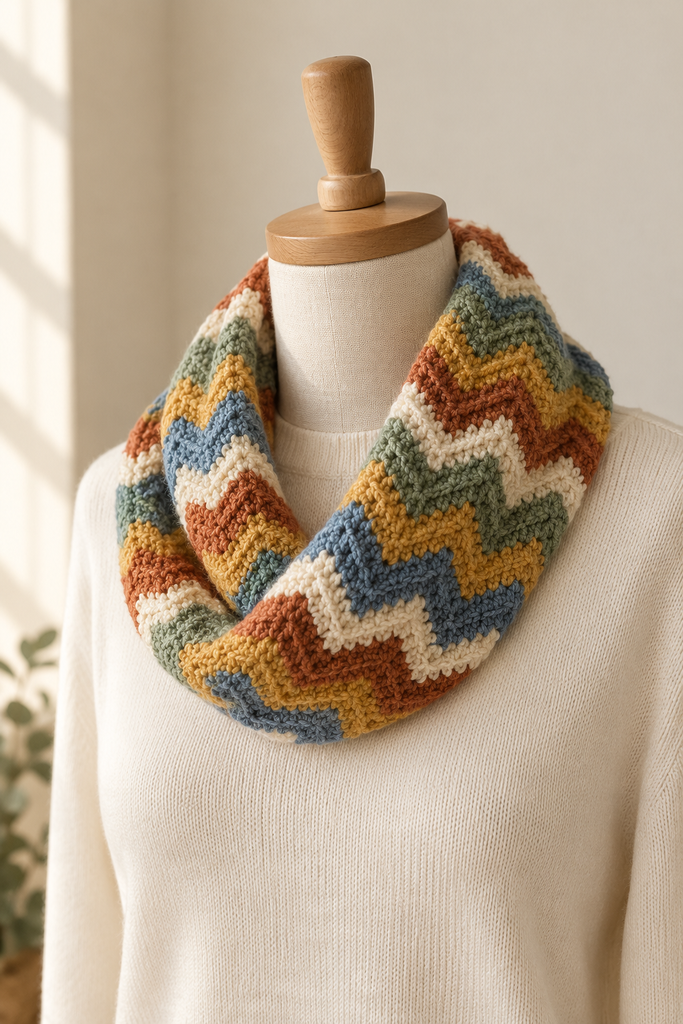
The Cowl size sits close at the neck, like a snood. The Infinity size doubles over for a two loop drape, so it works as an infinity scarf.
Skill level: beginner friendly. You need chain, double crochet, and one decrease. Time: an evening or two for the Cowl size.
Materials
- Worsted weight (4) yarn in five colours, labelled A to E. About 80 yds of each for the Cowl, 130 yds of each for the Infinity.
- 5.5mm (I/9) hook
- Blunt tapestry needle, scissors, stitch marker
This is a genuinely good stash project. Because you only need 80 yards of each colour, leftover skeins work perfectly. You do not need matching dye lots, and you do not need a full set of new yarn.
Pick colours with clear contrast between neighbours, though. Two similar mid tones side by side blur into each other and you lose the zigzag entirely.
[“Full beginner tool and yarn guide”]
Abbreviations
US crochet terms throughout.
| Short form | Full term |
|---|---|
| ch | Chain |
| sl st | Slip stitch |
| dc | Double crochet |
| dc3tog | Double crochet 3 together |
| 2 dc in | Two dc in the same stitch |
| st(s) | Stitch(es) |
| rnd(s) | Round(s) |
| rep | Repeat |
| { } | Stitch count for that round |
[ “Full US and UK abbreviations chart”]
Gauge
13 dc and 6 rnds = 4 in (10 cm)
Gauge is not critical here. A cowl that comes out an inch wider is still a cowl, and nobody measures your neck warmer.
However, if your gauge is wildly off, your yarn usage shifts too. So work a quick swatch if you are buying yarn specifically for this.
Anatomy of the Ripple
Before you start, it helps to know what you are actually building. Look at chevron fabric and you will see two shapes repeating.
The peak is the high point. You make it with two increases worked side by side. Those extra stitches fan the fabric outward, which pushes it up.
The valley is the low point. You make it with one dc3tog, which pulls three stitches into one. That gathering drags the fabric down.
Each 15 stitch repeat holds exactly one of each. So the increases and the decrease cancel out, and your count stays put.
Then, as you stack the rounds, every peak sits directly above the peak below it. That vertical alignment is what holds the wave in shape all the way up the cowl. Lose it and your stripes start sliding sideways.
Why Work It in the Round
You could crochet a chevron scarf flat in rows and seam it. Plenty of patterns do. But working in the round solves three problems at once.
No seam. A seam on a ripple fabric has to match peak to peak and valley to valley, and if it is off by even one stitch the join announces itself. Working in the round removes the problem entirely.
No turning. Every round has the right side facing you, so your stripes stay clean and you never have to think about which way round you are.
Cleaner colour changes. Because you join every round in the same place, all sixteen colour joins stack into one vertical column. That column becomes the back of the cowl, where nobody looks.
The trade is that you commit to the circumference at the foundation chain. So measure before you start, rather than after.
The Special Stitch: dc3tog
This is the only stitch you might not already know, and it forms every valley in the cowl. It turns three stitches into one.
Step 1. Yarn over, insert hook in the next st, yarn over and pull up a loop, yarn over and pull through two loops. You now have two loops on the hook.
Step 2. Repeat that into the next st. Three loops on the hook.
Step 3. Repeat once more into the third st. Four loops on the hook.
Step 4. Yarn over and pull through all four loops.
Count the loops before you close. Four, every time. Because if you close over three, you have worked a dc2tog instead and your stitch count climbs by one.
Pattern Notes
Work in joined rounds. Join at the end of every round and cut the yarn, because you change colour every time.
The ch 2 counts as the first dc here and throughout.
Join each new colour with a sl st in the top of the previous round’s ch 2, so all your joins line up in one column.
Count at the end of every round, before you fasten off. Fixing a round you just finished takes two minutes. Fixing one from four colours ago does not.
The Pattern
The numbers below give the Cowl size first. Infinity follows in brackets: 90 (150) sts, 6 (10) repeats.
Colour order
Work one round in each colour, in the order A, B, C, D, E, then start again at A. Sixteen rounds in total, so you finish on A.
Foundation
With colour A: ch 90 (150). Being careful not to twist the chain, join with sl st to the first ch to form a ring.
Take your time here. A twisted foundation is the one mistake in this pattern you cannot fix later. So lay the whole chain flat on a table and check that the bottom edge runs the same way all the way round before you join.
Round 1
Ch 2 (counts as the first dc). Dc in next 4 ch, dc3tog over next 3 ch, dc in next 5 ch, 2 dc in each of next 2 ch, *dc in next 5 ch, dc3tog over next 3 ch, dc in next 5 ch, 2 dc in each of next 2 ch*; rep from * to * around. Join with sl st to top of ch 2. Fasten off A. {90 (150)}
Rounds 2 to 16
Join the next colour with sl st in the top of the ch 2.
Ch 2, dc in next 4 sts, dc3tog over next 3 sts, dc in next 5 sts, 2 dc in each of next 2 sts, *dc in next 5 sts, dc3tog over next 3 sts, dc in next 5 sts, 2 dc in each of next 2 sts*; rep from * to * around. Join with sl st to top of ch 2. Fasten off. {90 (150)}
Now repeat Round 2 through Round 16, changing colour each time. The cowl should measure about 10.5 in (27 cm) tall.
Keeping Your Place
After the first couple of rounds you can stop counting to five and start reading the fabric instead.
Your dc3tog always sits directly above the dc3tog below it. And your two increases always sit directly above the two increases below them.
So once the wave is established, simply work each shaping stitch into the point of the shape underneath it. The fabric tells you where to go.
If a peak or valley starts drifting sideways, the count slipped a round or two earlier. That is where to look, not at the round you are on.
Finishing
Weave in every end. There are thirty two of them on the Cowl size, and that is genuinely the real work in this project. Thread each one onto a tapestry needle, run it through the back of several stitches, then change direction at least twice before trimming.
Work along the colour joins, not across them. An end woven into its own colour disappears completely. However, the same end woven into the stripe above it shows as a smudge on the right side. This one detail separates a handmade cowl from a homemade one.
Blocking is optional. A light steam along the top and bottom edges settles the peaks and valleys into an even wave. Do not press, because that flattens the ripple you just built.
About the edges
The top and bottom edges are meant to zigzag. That is the ripple, not a mistake, so adding a straight border to tidy it up removes the whole effect.
But if you want a cleaner finish, work one round of sl st in each st along both edges in colour A. It follows the wave and firms up the edge without flattening it.
Variations
| Variation | What to change |
|---|---|
| Two colours | Alternate A and B every round for a classic zigzag. Far fewer ends to weave |
| Gradient | Five shades of one colour, darkest at the bottom. Reads as one piece rather than stripes |
| Wider waves | Use a 21 st repeat: dc in next 8, dc3tog, dc in next 8, 2 dc in each of next 2 |
| Matching scarf | Work the same repeat flat in rows, turning at the end of each row |
| Deeper cowl | Add rounds in multiples of five, so the colour sequence still lands on A |
The two colour version is worth trying first if the thought of thirty two ends puts you off. You get the same zigzag with a third of the finishing work.
Troubleshooting
My chain twisted before I joined. Unfortunately there is no fix. Undo the join, straighten the chain against a table edge, and rejoin. Then check it twice before you work round 1.
My stitch count is dropping. You are probably missing one of the two increases at the peak. Each repeat needs one dc3tog and two separate increases.
My stitch count is climbing. A dc3tog worked over two stitches instead of three. So count the stitches you consume, not just the ones you make.
The ripple looks flat and shallow. Either your tension is loose, or the repeat is too wide for your yarn. Go down a hook size, because deeper waves need tighter fabric.
The peaks do not line up between rounds. Work your dc3tog directly above the previous dc3tog, and your increases directly above the previous increases. If they drift, the count slipped somewhere earlier.
My colour joins look messy. Join each new colour in the top of the ch 2 from the round below. Then every join stacks in the same place and becomes the back of the cowl.
Care
Check your yarn label first. Most worsted acrylic washes on a cool delicate cycle, while wool and wool blends usually need hand washing.
Either way, dry flat rather than hanging. Otherwise a wet cowl stretches, and the ripple sags out of shape.
FAQ
What is a chevron crochet pattern?
A chevron pattern creates a zigzag fabric by pairing increases and decreases across each row or round. Increases fan the fabric upward into peaks, decreases pull it down into valleys, and the two cancel out so the stitch count stays the same.
How many stitches for a crochet cowl?
For this pattern, 90 stitches gives a 28 inch cowl and 150 gives a 46 inch infinity scarf. Any multiple of 15 works, so you can size it to whatever you want.
How much yarn does a crochet cowl use?
About 400 yards of worsted weight yarn in total for the smaller size, split across five colours at roughly 80 yards each. The infinity size needs around 650 yards.
What is dc3tog in crochet?
Dc3tog means double crochet three together. You work three unfinished double crochets into three separate stitches, then close all four loops on your hook at once, turning three stitches into one.
Why is my chevron crochet not lining up?
Your stitch count slipped somewhere. Every peak must sit directly above the peak below it, and every valley above the valley below it. Check your count at the end of each round to catch it early.
Can I crochet a chevron cowl with two colours?
Yes. Alternate two colours every round for a classic zigzag. You get the same texture with far fewer ends to weave in, which makes it a much faster finish.
Can I sell cowls made from this pattern?
Yes, sell finished cowls freely. Please do not copy or redistribute the written pattern itself. A link back is always appreciated.
One Repeat, Over and Over
That is the whole pattern. Fifteen stitches, one decrease, two increases, five colours in rotation.
The chevron looks complicated from the outside, which is exactly why it makes such a good gift. Nobody who receives one will believe you when you tell them it was a single repeat.
Want the printable version? Etsy Shop Crochet Cravings Shop — five pages, both sizes, every step photographed.
