
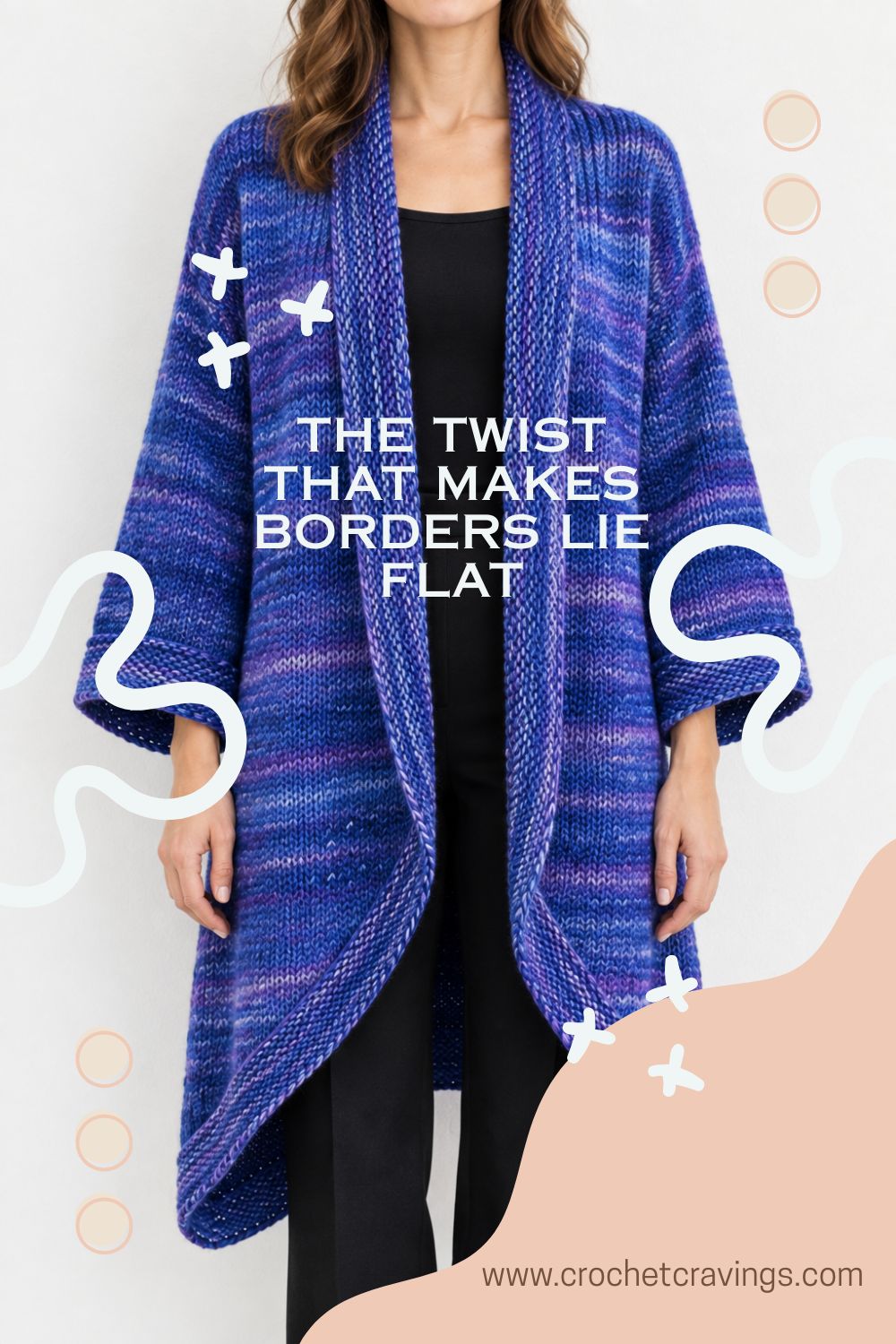
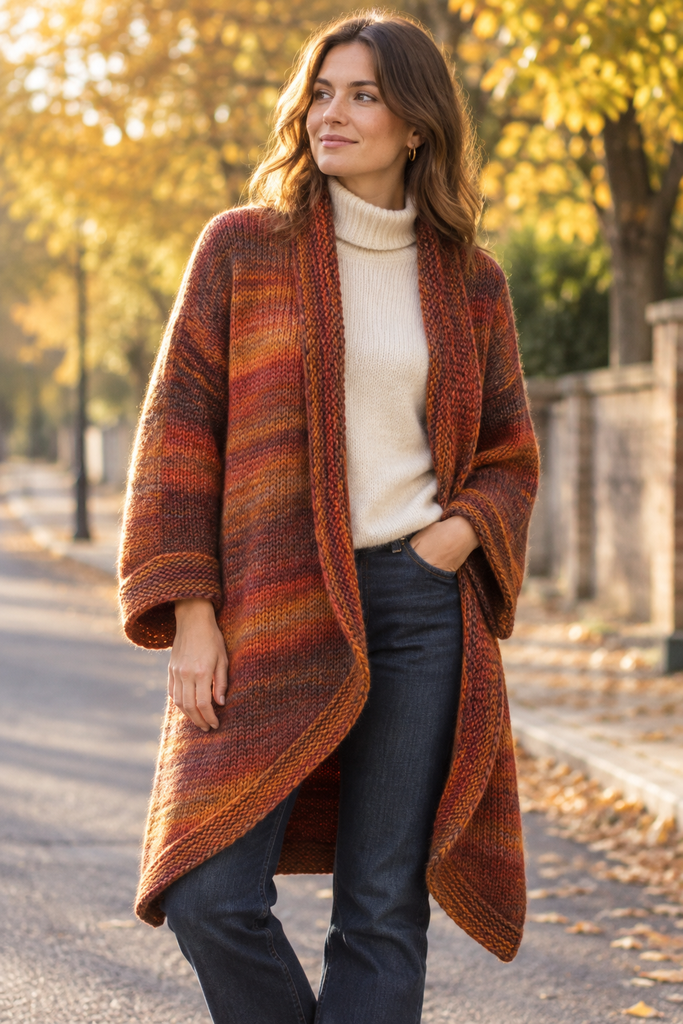
There is a particular kind of knitted coat that never quite goes out of style. Long, open at the front, soft enough to fall in a drape rather than hang in a line, big enough to wear over anything.
The Indigo Coat is that. Knee-skimming, oversized on purpose, worn open with a waterfall front and a garter stitch border running right the way around the outside.
Purchase Cardigan Pattern on our Etsy Shop
What makes it worth knitting is not the stitch pattern, because there is not one. It is plain stocking stitch from hem to shoulder. All the shape comes from where stitches are added and taken away, which means you can watch television while you knit it and still end up with something that looks like it came from a shop.
Here is how the construction works, what to know before you cast on, and who this coat is actually for.
What Makes This Coat Different
Most cardigan patterns have you knit two fronts, a back, and then two sleeves, and then set those sleeves into armholes. Setting in a sleeve is the step that puts people off garment knitting entirely, and fairly so.
This coat has no sleeves to set in.
Each sleeve is cast on directly at the side edge of its body piece, partway up. You cast on a large block of stitches in one row, keep knitting, and the sleeve grows out sideways from the body as one continuous piece of fabric. When you seam the piece later, the underarm closes itself.
Three pieces total. A right front, a left front, and a back. That is the whole garment.
The other unusual part is that the coat is asymmetric by design, so the two fronts are not mirror images of each other. They have genuinely different instructions. That asymmetry is what gives the front its drape rather than a straight vertical opening.
The Garter Border Trick
The border is one long strip of garter stitch, 20 stitches wide, knitted separately and then sewn around the entire outer edge of the coat. Hem, front, neck, other front, hem.
The interesting bit is what happens at the corners.
At each corner you twist the band over and keep sewing along its opposite edge. That half turn is what lets a straight strip of fabric go around a right angle and still lie flat instead of buckling or gathering.
It sounds like a mistake the first time you do it. It is not. It is the entire reason the border sits properly, and it is one of those techniques that transfers to every other project you make with an applied band.
About the Shorthand
The pattern uses a compact notation so each piece fits on a single page. It looks alarming for about ninety seconds and then it is obvious.
Every instruction has four parts, always in the same order:
| Part | What it does |
|---|---|
| > or < | > takes stitches away. < adds them |
| number + s | how many stitches |
| L, Rt or ee | which edge: left, right, or each end |
| when | a row number, the next row, or a repeat |
So >1s L ev 5r x 19 reads as: decrease one stitch at the left edge, every fifth row, nineteen times.
Once that clicks, a whole garment piece fits on one page instead of six, and you spend far less time hunting for your place.
Important: in this system, left and right mean the left and right edge of the knitting as you look at it with the right side facing. Not the wearer’s left and right. Getting that backwards is the single most common way to end up with two of the same front.
The pattern includes a plain-English column beside every instruction, so you are never relying on the shorthand alone.
Yarn and Gauge
Yarn: DK weight, around 950g total. The sample uses James C. Brett Marble DK in shade MT34, a self-striping blue and purple blend that shifts gradually through the piece.
That self-striping quality does a lot of work here. On a plain stocking stitch garment this size, a solid colour can read flat. A slow colour shift gives the fabric movement without you having to do anything.
Needles: 4.5mm.
Gauge: 20.7 stitches and 29.4 rows to 10cm in stocking stitch.
Why row gauge matters more than usual here
On most patterns you can be slightly off on row gauge and get away with it, because the pattern tells you to knit until a piece measures a certain length.
This one does not work that way. Every shaping instruction is counted in rows. The pattern tells you to decrease on row 65, cast on at row 102, work straight to row 136.
If your row gauge is off by even a little, those numbers compound over 250 rows and the whole coat comes out longer or shorter than intended.
So swatch, and check both numbers, not just the stitch count. Adjust your needle size until they both match. It is twenty minutes that saves a month.
Purchase Cardigan Pattern on our Etsy Shop
Who This Coat Is For
Good fit if you:
- Are comfortable with stocking stitch, increases and decreases
- Can cast on and cast off mid-row
- Want a garment project that does not require constant attention
- Have been avoiding garments because of set-in sleeves
Maybe not yet if you:
- Have never knitted a garment at all
- Dislike seaming, since there is a fair amount of it here
- Want something quick, because 950g of DK is a genuine commitment
This is an intermediate pattern, and I would rather say so than have you buy it and struggle. It is not technically difficult, but it is long, and some sections shape both edges at the same time, which takes concentration.
A Note on Time
Nobody knits a 950g DK coat in a weekend. Budget four to eight weeks of evening knitting, more if you are new to garments.
The useful thing is that the plain stocking stitch sections are genuinely mindless, so it is a good commute or television project in a way that a cabled or colourwork garment never is.
More Blogs on Crochet Patterns
FAQ
What is a waterfall cardigan?
A waterfall cardigan is an open-front cardigan with fronts cut or shaped so the edges fall in a soft cascading drape rather than hanging straight. It is worn open, with no buttons or fastening, and the drape comes from the shaping of the front pieces.
What yarn is best for a draped cardigan?
DK weight with good drape. Wool blends, merino, and wool-acrylic mixes all work well. Avoid stiff pure cottons, which hold their shape rather than falling, and avoid anything very fuzzy, which obscures the stocking stitch.
How much yarn does an oversized knit coat need?
This one takes around 950g of DK weight yarn. Oversized garments in DK typically run between 800g and 1,200g depending on length and body size, which is considerably more than most people expect.
Can a beginner knit a cardigan?
A confident beginner can, if the pattern avoids set-in sleeves. Look for patterns with sleeves built into the body pieces, which removes the hardest part of garment construction. This coat uses that approach, though its length and row-counted shaping make it better suited to someone with at least one finished garment behind them.
Do I really need to knit a gauge swatch?
For this pattern, yes, and for row gauge as well as stitch gauge. All the shaping is counted in rows rather than measured in centimetres, so a small row gauge difference compounds across 250 rows and changes the finished length significantly.
What does “at the same time” mean in a knitting pattern?
It means two sets of shaping instructions happen across the same rows, usually one at each edge of the piece. You work both together rather than finishing one and then starting the other.
Get the Pattern
The full 13 page PDF includes all three pieces, complete schematics with every measurement, step photos for the border corners and seaming, and a plain-English translation beside every line of shorthand.
