
This post contains affiliate links. If you buy through them I earn a small commission at no extra cost to you. I only recommend gear I would hand to a friend.
Walk into a craft store to buy your first crochet supplies and you will be looking at an entire aisle. Hook sets, forty yarn weights, blocking mats, yarn winders, ergonomic grips, gadgets you cannot identify.
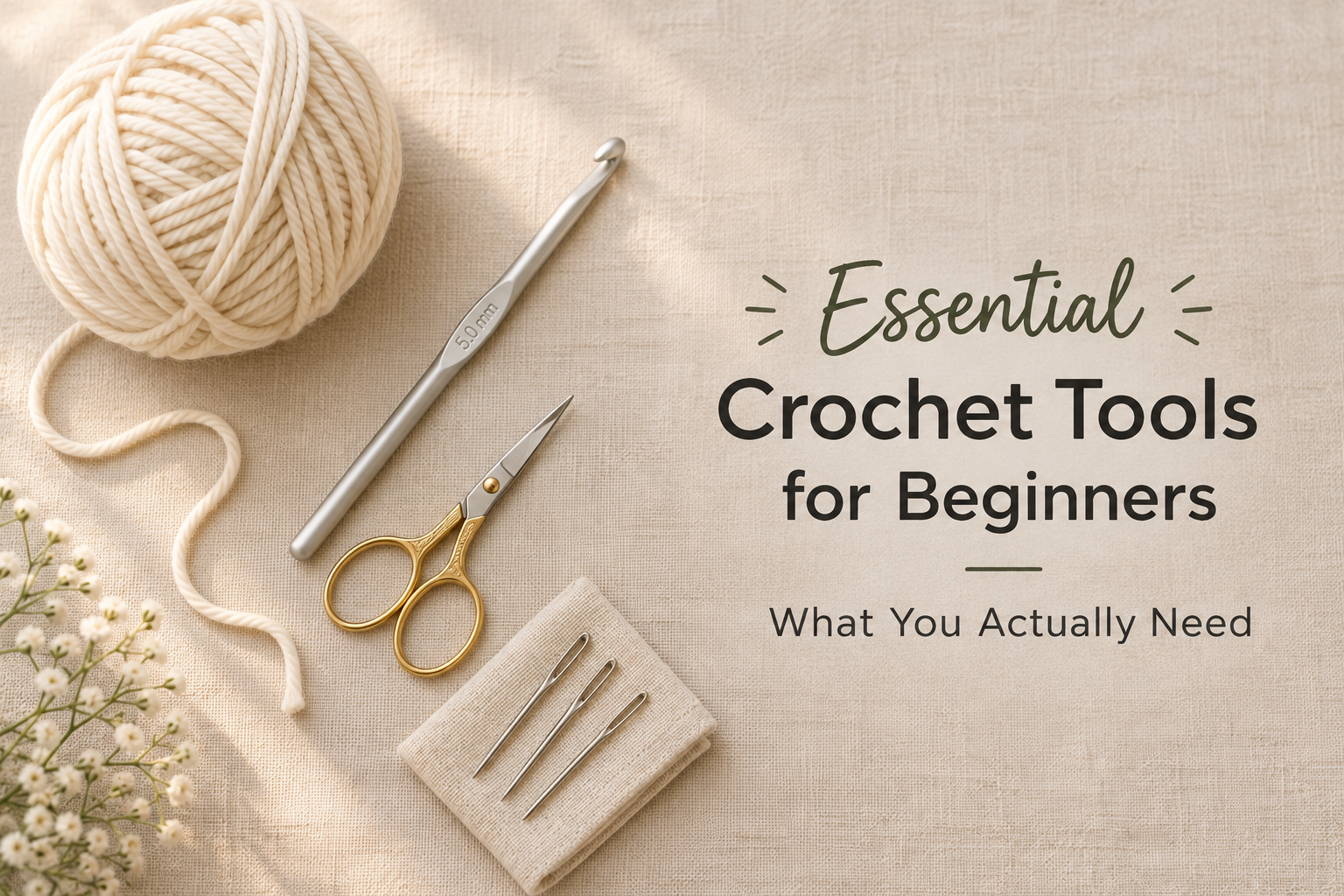
Here is the honest answer nobody selling you a 200 piece kit wants to give you: you need four things, and they cost under $20 together.
Everything else is an upgrade you buy later, once you know whether you even like this. This guide sorts every crochet tool into what you need on day one, what to add at month three, and what to genuinely skip.
The Short Answer: Your Day One Kit
| Tool | What it does | Budget |
|---|---|---|
| 5.0mm (H/8) crochet hook | The hook you make every stitch with | $2 to $8 |
| Worsted weight yarn, light colour | Your practice and first project yarn | $4 to $7 |
| Small sharp scissors | Cutting yarn cleanly | $5 to $10 |
| Tapestry needle | Weaving in ends so nothing unravels | $3 to $5 |
That is it. One hook, one ball of yarn, scissors, a blunt needle. You can make a scarf, a dishcloth, a beanie and a granny square with exactly that list.
Now here is how to choose each one so you do not buy the wrong version.
1. The Crochet Hook
What it does
The hook is the whole craft. It pulls loops through loops, and every single stitch you will ever make is some variation of that.
What to buy first
A 5.0mm hook, sized H/8 in US letters. This is the standard beginner size because it pairs with worsted weight yarn, which is the most common and forgiving yarn there is.
Do not buy a set yet. A 12 piece hook set sounds like better value, but you will use one hook for your first two months and the other eleven will sit in a drawer. Buy one good hook now and a set later, when you know which sizes you actually reach for.
Hook materials compared
| Material | Feel | Best for |
|---|---|---|
| Aluminium | Fast, slippery, cheap | Most beginners, and the safest default |
| Bamboo or wood | Warm, grippier, slower | Slippery yarns, and anyone whose stitches slide off |
| Plastic | Light, cheap, drags a bit | Very large hooks and chunky yarn |
| Ergonomic (rubber grip) | Cushioned, wide handle | Hand pain, arthritis, long sessions |
Aluminium is the right first buy for most people. Brands like Boye and Susan Bates are inexpensive and completely fine.
Should you go straight to ergonomic? If you have any hand or wrist pain, yes. Clover Amour and similar soft grip hooks run roughly $8 to $12 each and they are worth every cent if your hands hurt. If your hands are fine, start cheap. You can always upgrade.
[Beginner Crochet Kit: budget aluminium hook] | [Crochet Hooks (12 sizes): ergonomic soft grip hook]
Beginner mistake to avoid
Buying a tiny hook. A 2.0mm hook with thin thread is how a lot of people quit in week one, because the stitches are too small to see what you are doing. Bigger hook, chunkier yarn, faster progress.
2. The Yarn
What it does
Obvious, but the choice matters more than beginners expect. The wrong yarn makes crochet feel impossible.
What to buy first
Worsted weight (weight 4) acrylic, in a light solid colour. Cream, light grey, pale blue. Anything you can actually see your stitches in.
Three rules for your first yarn:
- Light colours only. You cannot see stitch definition in navy or black. This is the single most common beginner complaint and it is entirely a yarn colour problem.
- Solid, not variegated. Multicoloured yarn hides your mistakes from you, which sounds nice and is actually the opposite of what you want while learning.
- Smooth, not fuzzy. No chenille, no eyelash, no boucle. Those yarns are almost impossible to work with when you are learning, because you cannot see the stitches at all.
A single skein of basic worsted acrylic runs about $4 to $7 and will get you through weeks of practice.
Yarn fibres compared
| Fibre | Cost | Best for | Watch out for |
|---|---|---|---|
| Acrylic | Low | Practice, blankets, amigurumi, gifts | Can feel squeaky on the hook |
| Cotton | Medium | Dishcloths, market bags, summer tops, amigurumi | Less stretch, harder on hands |
| Wool | Higher | Hats, scarves, garments, blocking beautifully | Usually hand wash, can itch |
| Blends | Varies | Softness with easier care | Read the label for the mix |
Start with acrylic. Move to cotton when you make your first amigurumi. Save wool for when you make something you want to keep for years.
Want the full breakdown? [Crochet Basics “Choosing the best yarn for beginners”].
[Beginners Kit: beginner worsted acrylic yarn]
3. Scissors
What it does
Cuts your yarn. That is the whole job, but a clean cut matters more than you would think when you are threading a tapestry needle.
What to buy first
Small, sharp embroidery or craft scissors. Around 4 inches. They live in your project bag and they never, ever get used on paper.
You do not need fancy ones. A $6 pair of sharp embroidery scissors outperforms the $25 novelty stork scissors that look prettier in photos.
Travel note: small scissors are usually not allowed in carry-on luggage. If you crochet on planes, get a yarn cutter pendant instead, which most airlines permit and which costs under $10.
[Beginners Kit: small craft scissors]
4. Tapestry Needle
What it does
Weaves your loose yarn ends back into the fabric so your finished project does not slowly unravel.
Skipping this step is why a beginner’s first scarf falls apart. It is not optional.
What to buy first
A blunt-tipped tapestry or darning needle with a large eye. They come in multipacks for about $3 to $5 and one pack lasts years.
Blunt tip is the key detail. A sharp needle splits the yarn instead of sliding between the strands, which makes a messy weave. Bent-tip tapestry needles cost a dollar or two more and make the job noticeably easier, which is a rare case of a cheap upgrade being genuinely worth it.
New to finishing? [Chain Crochet“How to weave in ends so they never come loose”].
Crochet Hook Size Chart
Once you move past your first hook, this is the chart you will keep coming back to. Match the hook to the yarn weight the pattern calls for.
| US size | Metric | Yarn weight | Typical projects |
|---|---|---|---|
| B/1 | 2.25mm | Lace, thread | Doilies, fine amigurumi |
| C/2 | 2.75mm | Fingering (1) | Socks, delicate work |
| D/3 | 3.25mm | Fingering (1) | Lightweight garments |
| E/4 | 3.50mm | Sport (2) | Baby items |
| F/5 | 3.75mm | Sport / DK (2 to 3) | Amigurumi, baby clothes |
| G/6 | 4.00mm | DK (3) | Amigurumi, light garments |
| 7 | 4.50mm | DK / worsted (3 to 4) | Garments |
| H/8 | 5.00mm | Worsted (4) | Scarves, hats, blankets, the beginner default |
| I/9 | 5.50mm | Worsted (4) | Blankets, bags |
| J/10 | 6.00mm | Worsted / bulky (4 to 5) | Chunky scarves |
| K/10.5 | 6.50mm | Bulky (5) | Fast blankets |
| L/11 | 8.00mm | Bulky (5) | Chunky hats |
| M/N/13 | 9.00mm | Super bulky (6) | Arm-knit style throws |
| N/P/15 | 10.00mm | Super bulky (6) | Rugs, baskets |
Two important notes. For amigurumi, deliberately go one or two sizes smaller than the yarn label suggests, so the fabric is dense enough that stuffing does not show through. And US letter sizing is not perfectly standardised between brands, so trust the millimetre number over the letter every time.
Pattern shorthand confusing you? [Crochet Abbreviations “Full crochet abbreviations chart”].
Add These at Month Three
You do not need these to start. You will want them by your third project.
Stitch markers ($5 to $8) Locking markers, not the closed ring kind. Rings are for knitting and will not come off crochet stitches easily. You need these the moment you crochet in the round, which is any hat or amigurumi. A paperclip or a scrap of contrasting yarn works in a pinch.
Measuring tape ($3 to $5) The moment you make anything that has to fit a person, you need to check gauge. A soft retractable tape is a few dollars and prevents a lot of wasted yarn.
Row counter ($5 to $8) A clicker, or a free phone app. Genuinely useful on long repetitive projects like blankets where losing count costs you an hour.
Project bag ($10 to $25) Yarn that lives loose in a room gets tangled, dusty and found by pets. Any zip tote works. This is where a lot of crocheters happily overspend and nobody regrets it.
Add These When You Actually Need Them
Blocking mats and pins ($15 to $30) Blocking is wetting or steaming a finished piece and pinning it into shape while it dries. It is transformative for granny squares, doilies, shawls and garments, and completely pointless for amigurumi. Buy it the week you make your first lacy thing, not before. Interlocking foam mats from the kids’ section of any store work identically to the ones sold as blocking mats, for a fraction of the price.
Yarn winder and swift ($25 to $60) Turns hanks into usable cakes. You only need this if you buy yarn that comes in twisted hanks, which mostly means nicer wool and hand dyed yarn. If you buy supermarket acrylic in ready-to-use skeins, you will never need one.
Ergonomic hook set ($25 to $50) The right time to buy a full set is when you have hand fatigue and you know your favourite sizes. Not on day one.
Hook case or organiser ($10 to $20) Genuinely nice once you own more than five hooks. Before that, a pencil case does the job.
Tools You Can Skip
Being straight with you about the stuff that sells well and gets used rarely:
- 200 piece mega kits. Padded out with duplicate markers, plastic needles and hook sizes you will never touch. You are paying for the box.
- Novelty shaped scissors. Beautiful. Usually blunter than a $6 pair of embroidery scissors.
- Yarn bowls. Lovely on a shelf, and a mug or a zip bag with a hole in the corner solves the same problem for free. Buy one because you want one, not because you need one.
- Pom pom makers. Only if you plan to make a lot of pom poms. A fork and a piece of cardboard both work.
- Crochet “assist” gadgets. Tension rings, hook holders, stitch spacers. Almost all of them solve a problem that goes away on its own with two more weeks of practice.
Three Starter Kits at Three Budgets
The $20 Test Run
One 5.0mm aluminium hook, one skein of light worsted acrylic, small craft scissors, a pack of tapestry needles.
Best for: finding out whether you like crochet before spending real money. This is what I would tell any friend to buy first.
The $50 Committed Beginner
One ergonomic 5.0mm hook, a 4.00mm and 6.00mm hook, three skeins of yarn in different light colours, sharp scissors, bent-tip tapestry needles, locking stitch markers, measuring tape, a simple project bag.
Best for: someone who already knows they will stick with it, or a solid gift for a beginner.
The $100 Gift Kit
Full ergonomic hook set, a small selection of cotton and acrylic yarn, all the notions above, blocking mats and pins, a proper project bag, and a beginner pattern book.
Best for: gifting to someone who has mentioned wanting to learn. Add a printed pattern and it becomes a genuinely thoughtful present.
Caring for Your Tools
Not glamorous, but it keeps cheap tools working for years.
- Wipe metal hooks occasionally. Yarn fibre and hand oils build up and make them drag.
- Never use fabric scissors on paper. Paper dulls blades faster than anything else.
- Store yarn in sealed containers. Moths are a real problem for wool, and dust is a real problem for everything.
- Keep hooks in a case, not loose in a bag. Wooden hooks snap, and coated ergonomic grips get gouged.
- Rewind partially used skeins. Loose ends turn into a knot the next time you open the bag.
FAQ
What tools do I need to start crocheting?
Four things: a 5.0mm (H/8) crochet hook, a skein of light coloured worsted weight yarn, small sharp scissors, and a blunt tapestry needle for weaving in ends. That set costs under $20 and covers your first several projects.
What size crochet hook is best for beginners?
A 5.0mm hook, listed as H/8 in US sizing. It pairs with worsted weight yarn, which is the most widely available and easiest yarn to learn with. Bigger stitches are easier to see, which makes learning noticeably faster.
Is it worth buying a crochet kit for beginners?
Usually not the large ones. Big kits pad the piece count with duplicates and sizes you will not use. A small four item kit is fine, but buying the individual pieces yourself is normally cheaper and gets you better quality where it matters, which is the hook.
What is the best yarn for a beginner?
Smooth worsted weight acrylic in a light solid colour. Acrylic is cheap, durable and machine washable. Light colours let you see your stitches, which matters far more than beginners expect. Avoid fuzzy, dark or variegated yarn until you are comfortable.
Do I need ergonomic crochet hooks?
Only if you have hand or wrist discomfort, or you crochet for long stretches. They cost roughly three to four times a basic aluminium hook. If your hands feel fine, start with a cheap hook and upgrade if you develop fatigue.
What is the difference between US and metric crochet hook sizes?
US sizes use letters and numbers like H/8, while metric uses millimetres like 5.0mm. Letter sizing is not perfectly consistent between manufacturers, so always match on the millimetre measurement when following a pattern.
How much does it cost to start crocheting?
Around $20 for a genuine starter set of hook, yarn, scissors and needle. A more complete kit with multiple hooks and notions runs $50 to $60. Crochet is one of the cheapest crafts to begin.
Start With Four Things
Every experienced crocheter you follow started with one hook and one ball of yarn. The tool drawer came later, and every item in it was bought because a specific project demanded it.
Buy the four essentials. Make something. Let the rest of your kit build itself.
