
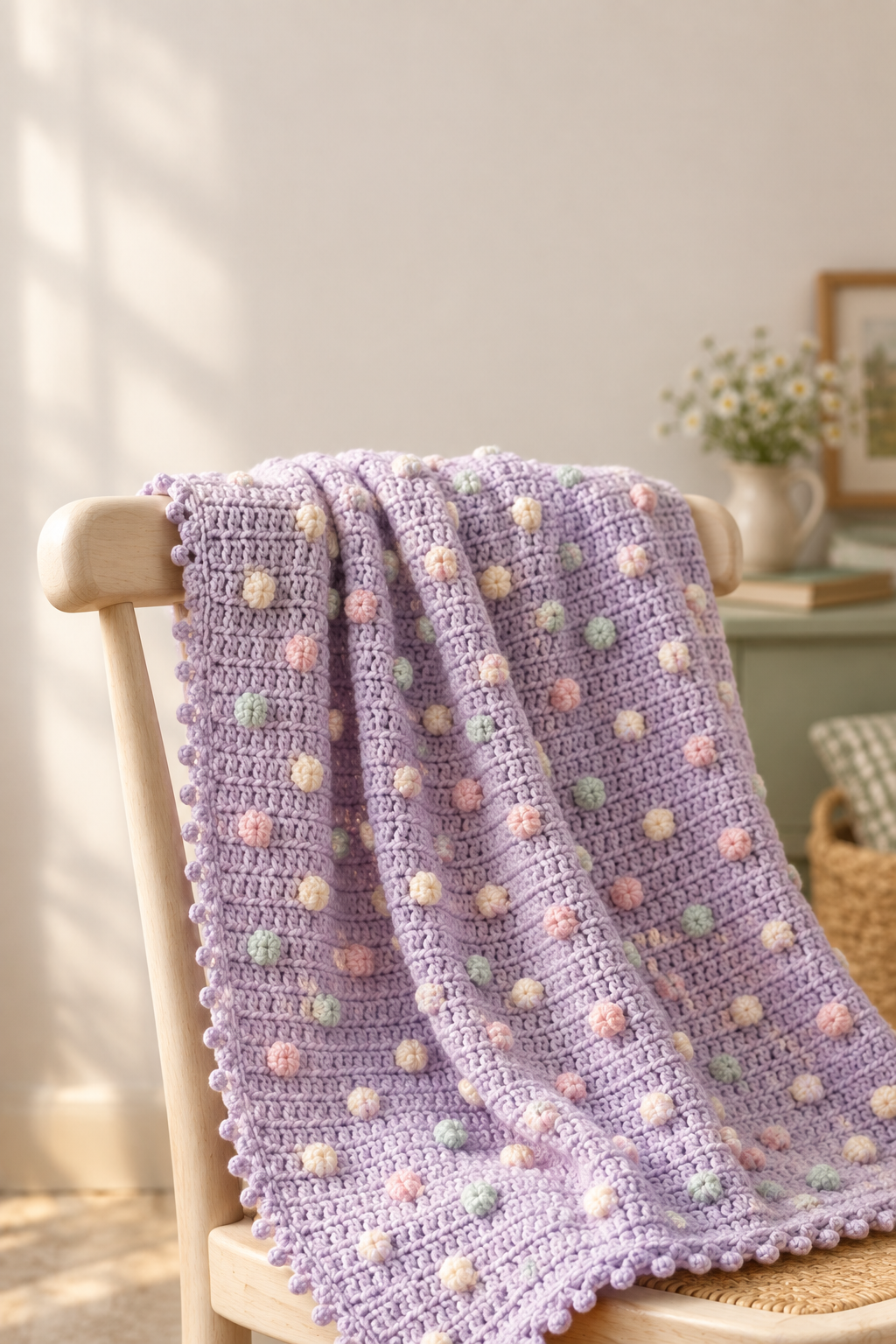
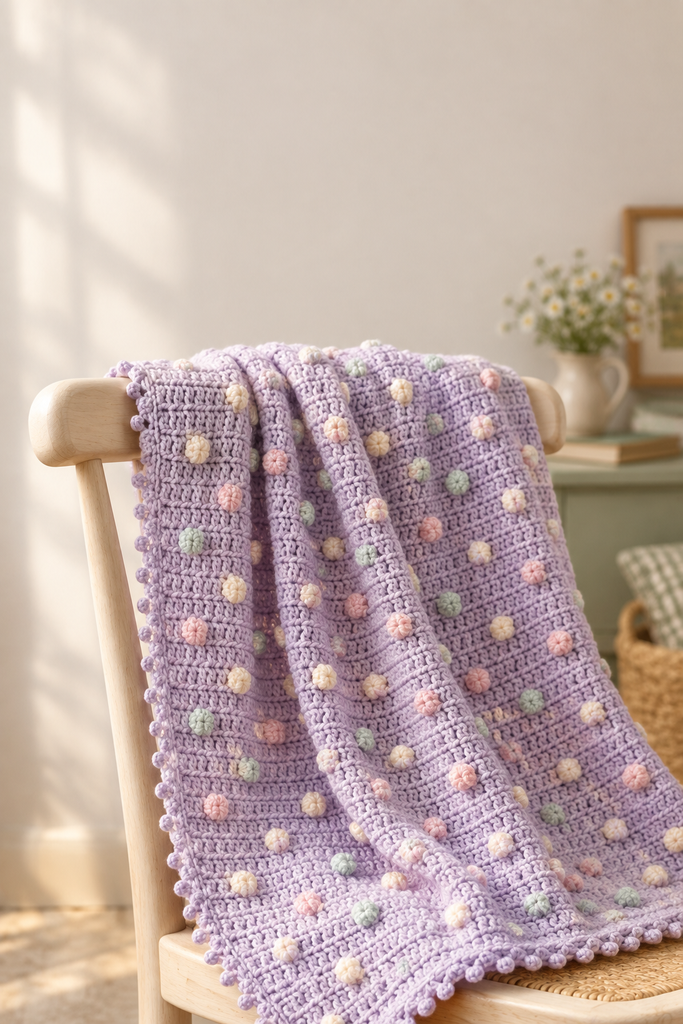
This is the blanket I hand to people who say they want to make a blanket but do not want to make a boring blanket.
It is four rows. Two of them are plain double crochet. The other two have bobbles in them. That is the entire pattern, repeated until you run out of patience or yarn, and the result is a dense field of raised bumps in a diamond grid that looks like it took far more skill than it did.
No colour changes. No counting complicated repeats. No chart to decipher. If you can double crochet and you can work a bobble, you can make this.
Purchase our latest Blanket Patterns on our Etsy Shop
What You’ll Make
| Size | Finished dimensions | Starting chain | Rows |
|---|---|---|---|
| Baby | approx 30 x 35 in (76 x 89 cm) | 92 | 57 |
| Lapghan | approx 40 x 50 in (102 x 127 cm) | 124 | 81 |
| Throw | approx 50 x 60 in (127 x 152 cm) | 152 | 97 |
Skill level: advanced beginner. You need chain, double crochet, and the bobble. Time: a weekend for the baby size, a couple of weeks of evenings for the throw.
Materials
| Item | Baby | Lapghan | Throw |
|---|---|---|---|
| Worsted weight (4) yarn | approx 1,300 yds | approx 2,400 yds | approx 3,600 yds |
| Hook | 5.5mm (I/9) | 5.5mm (I/9) | 5.5mm (I/9) |
Plus a blunt tapestry needle and scissors.
Buy more yarn than you think. Bobbles eat roughly a third more yarn than plain double crochet, and those estimates already account for it. Dye lots vary, so buy the full amount up front rather than topping up later.
Yarn choice matters here. Use a smooth solid colour. Bobbles vanish into variegated or fuzzy yarn, and all that texture work disappears. A soft acrylic or a cotton blend both work well. Cotton gives crisper definition, acrylic is softer and cheaper for something this size.
[ “Full beginner tool and yarn guide“]
Abbreviations
US crochet terms throughout.
| Short form | Full term |
|---|---|
| ch | Chain |
| sl st | Slip stitch |
| sc | Single crochet |
| dc | Double crochet |
| st / sts | Stitch / stitches |
| RS / WS | Right side / wrong side |
| rep | Repeat |
| * * | Repeat everything between the asterisks |
| { } | Stitch count at the end of that row |
[“Full US and UK abbreviations chart“]
Gauge
12 dc and 6.5 rows = 4 in (10 cm) using a 5.5mm hook and worsted weight yarn.
Gauge is not critical here, since a blanket that comes out two inches wider is still a blanket. But if yours is noticeably off, your finished size and yarn usage will shift, so work a quick swatch before buying six skeins.
The Bobble
Bobble = 5 unfinished dc worked into one st, closed together.
YO, insert hook into the st, YO and pull up a loop, YO and pull through 2 loops. That is one unfinished dc. Work four more into the same stitch. You will have 6 loops on the hook. YO and pull through all 6.
Count your loops before closing. Six, every time.
Pattern Notes
Work bobbles on WS rows only. Bobbles pop out on the side facing away from you. Rows 2 and 4 are wrong side rows, so the bumps land on the front where you want them. This is the one thing that will ruin the blanket if you get it backwards.
The ch 3 at the start of each row counts as the first dc. Work your last stitch of each row into the top of the previous row’s turning chain.
Push each bobble away from you with your thumb as you close it, so it settles on the right side.
Count at the end of every row. The number in curly brackets tells you what you should have. Catching an error on row 12 is annoying. Catching it on row 60 is heartbreaking.
Turn at the end of every row.
The Pattern
Instructions are written for the baby size. Numbers for lapghan and throw follow in brackets, like this: 90 (122, 150).
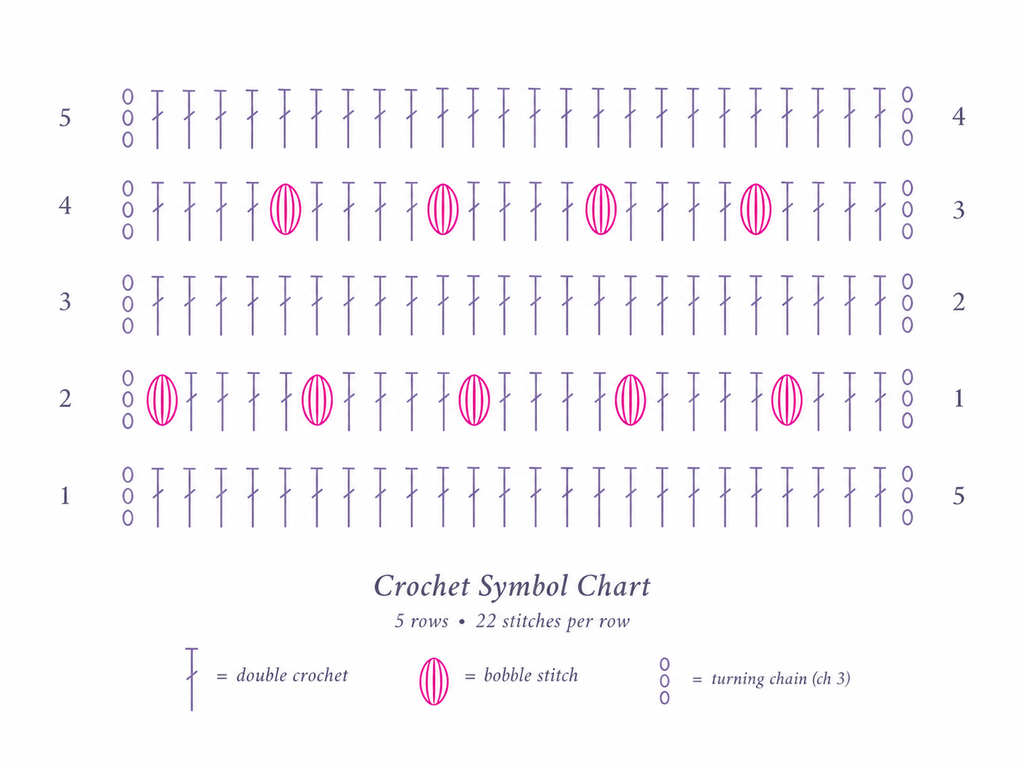
Foundation
Ch 92 (124, 152).
Row 1 (RS): dc in the 4th ch from hook and in each ch across. Turn. {90 (122, 150) sts}
The Four-Row Repeat
Row 2 (WS): ch 3, dc in next st, *bobble in next st, dc in next 3 sts*, rep from * to * across to end. Turn. {90 (122, 150) sts, 22 (30, 37) bobbles}
Row 3 (RS): ch 3, dc in each st across. Turn. {90 (122, 150)}
Row 4 (WS): ch 3, dc in next 3 sts, *bobble in next st, dc in next 3 sts*, rep from * to * until 2 sts remain, dc in last 2 sts. Turn. {90 (122, 150) sts, 21 (29, 36) bobbles}
Row 5 (RS): ch 3, dc in each st across. Turn. {90 (122, 150)}
Repeat
Repeat rows 2 to 5 a total of 14 (20, 24) times, ending after a row 5.
That gives you 57 (81, 97) rows including the foundation row.
Do not cut the yarn. Continue straight into the border.
Why the Offset Matters
Row 2 puts bobbles in every fourth stitch starting from stitch 3. Row 4 shifts them over by two, starting from stitch 5.
That two-stitch shift is what turns the blanket from stripes of bumps into a diamond grid. It is the difference between fabric that looks designed and fabric that looks like it happened by accident, and it costs you nothing.
Border
Simple, sturdy, and it stops the edges curling.
Round 1 (RS): ch 1, do not turn. Work sc evenly around the entire blanket, placing 3 sc in each corner. Along the top and bottom edges, work 1 sc in each st. Along the side edges, work approximately 2 sc for every row end. Sl st to the first sc to join.
Round 2: ch 1, sc in each st around, 3 sc in each corner st. Sl st to join.
Round 3 (optional scalloped edge): ch 1, sc in first st, *skip 1 st, 5 dc in next st, skip 1 st, sc in next st*, rep from * to * around. Sl st to join.
Fasten off, leaving a tail for weaving.
On the side edges: 2 sc per row end is a guideline, not a rule. If the edge ruffles, you are adding too many. If it pulls in and puckers, add a few more. Lay the blanket flat and look at it rather than counting.
Finishing
Weave in every end with a tapestry needle, going through the back of several stitches and changing direction at least twice. Blankets get washed and dragged around, and a single-direction weave works loose eventually.
Blocking is optional. Bobble fabric does not need it, and heavy blocking can actually flatten the texture you worked for. If your edges are wavy, a gentle steam along the border alone will sort it.
Baby blanket note: wash and dry the finished blanket before gifting it. It softens the fabric and confirms the yarn behaves.
Make It Any Size You Want
The formula is simple.
Stitch count must be a multiple of 4, plus 2.
So: 70, 74, 78, 82, 86, 90, 94 and so on. All valid.
Foundation chain = your stitch count + 2.
Rows: any number that follows 1 + a multiple of 4, so you always finish after a plain RS row. 57, 61, 65, 69, 73 and up.
Want a square baby blanket? Pick 110 sts and 73 rows. Want a long narrow runner? 50 sts and 129 rows. The four-row repeat does not care.
Colour Ideas
The pattern is written in one colour because bobbles carry the whole design on their own. But if you want to play:
- Solid neutral. Cream, oatmeal, soft grey. Lets the texture do everything. My default.
- Wide stripes. Change colour every 16 rows, at the end of a row 5. Four bobble bands per stripe.
- Ombré. Four or five shades of the same colour, darkest at the bottom, changing every 12 to 16 rows.
- Contrast border. Whole blanket in one colour, border in a second. Cheapest way to make it look considered.
- Colour-pop bobbles. Harder, but striking. Carry a second colour along the row and use it for bobbles only. Do this once you are comfortable with the plain version.
Avoid variegated yarn entirely. It fights the texture and neither one wins.
Troubleshooting
My bobbles are on the back. You worked them on a RS row. Rows 2 and 4 are WS rows. If you have turned an extra time somewhere, your row parity has slipped.
My blanket is getting narrower. You are missing the last stitch of rows. Because the ch 3 counts as a dc, your final stitch of each row goes into the top of the previous turning chain, not the stitch beside it. This is the single most common blanket mistake.
My blanket is getting wider. The opposite problem, working into both the turning chain and the stitch beneath it. Count every row.
Big holes next to my bobbles. Your closing pull-through is too loose. Hold the base of the bobble firmly and pull the final loop tight.
The edges are curling. Normal for double crochet fabric before the border goes on. The sc border fixes it.
I ran out of yarn. Bobble fabric is thirsty. Stop at the end of a row 5, add the border, and call it the size it is. A slightly smaller finished blanket beats a mismatched dye lot.
FAQ
How much yarn do I need for a bobble stitch blanket?
Roughly 1,300 yards of worsted weight for a 30 x 35 inch baby blanket, 2,400 yards for a lapghan, and 3,600 yards for a throw. Bobbles use about a third more yarn than plain double crochet, so buy the full amount up front to avoid dye lot mismatches.
Is a bobble stitch blanket good for beginners?
Yes, as long as you can double crochet. It is a four-row repeat with no colour changes and no shaping. The bobble is the only new skill and it takes about ten minutes to learn.
How long does a bobble blanket take?
A weekend of solid work for the baby size, and a couple of weeks of evenings for the throw. Bobble rows run slower than plain rows, so budget more time than a plain double crochet blanket of the same size.
Why are my bobbles on the wrong side?
Bobbles pop out on the side facing away from you as you work. In this pattern, rows 2 and 4 are wrong side rows so the bumps land on the front. If yours are on the back, check that you are turning at the end of every row.
What yarn is best for a bobble blanket?
Smooth worsted weight in a solid colour. Acrylic is soft, affordable and machine washable, which matters for a blanket. Cotton blends give crisper stitch definition. Avoid variegated or fuzzy yarn, which hides the texture completely.
Can I make this blanket bigger or smaller?
Yes. Chain any multiple of 4 plus 2, then add 2 more for the foundation. Work any number of rows following 1 plus a multiple of 4 so you finish after a plain right side row.
Is this blanket safe for a baby?
The fabric is dense with no long floats or loose loops, so it is a solid choice. Weave ends in thoroughly, changing direction at least twice, and wash it before gifting.
Go Make It
One four-row repeat, over and over, until it is as big as you want. That is genuinely the whole thing.
If you make one, I would love to see it. Tag me or send a photo through the [“contact page“].
More texture: [“Pumpkin Pattern”] | More patterns: Etsy Shop
